 Optimizely




The Digital Gap No One Talks About
Health systems have invested millions into digital front doors: patient portals, mobile apps, scheduling systems and redesigned websites. Yet for all that investment, there’s one glaring gap few organizations are addressing: onsite search.
It’s ironic. For patients, when they land on a healthcare website, the search bar is often the very first step in their digital journey. But for many health systems, site search is still treated as a passive utility rather than a core part of the digital experience. That disconnect creates frustration, increases call center volume and ultimately drives patients away.
Think of it this way: a health system would never build a call center without monitoring average handle time, customer satisfaction and call resolution rates. Yet when it comes to website search, many organizations fail to measure or improve the experience, even though it’s often the first interaction a patient has online.
The Role of Search in Patient Experience
More than 40 percent of healthcare website users start their journey in the search bar. They’re not casually browsing; they’re on a mission. A mom looking for a pediatric cardiologist. A patient trying to confirm whether a certain insurance plan is accepted. Someone searching for the right urgent care location at 9 p.m.
When those searches fail, the downstream effects ripple quickly. Patients can’t find providers, content goes undiscovered and call centers are flooded with questions that could and really should be answered online. In a competitive healthcare market, failed searches are lost opportunities for engagement, trust and access to care.
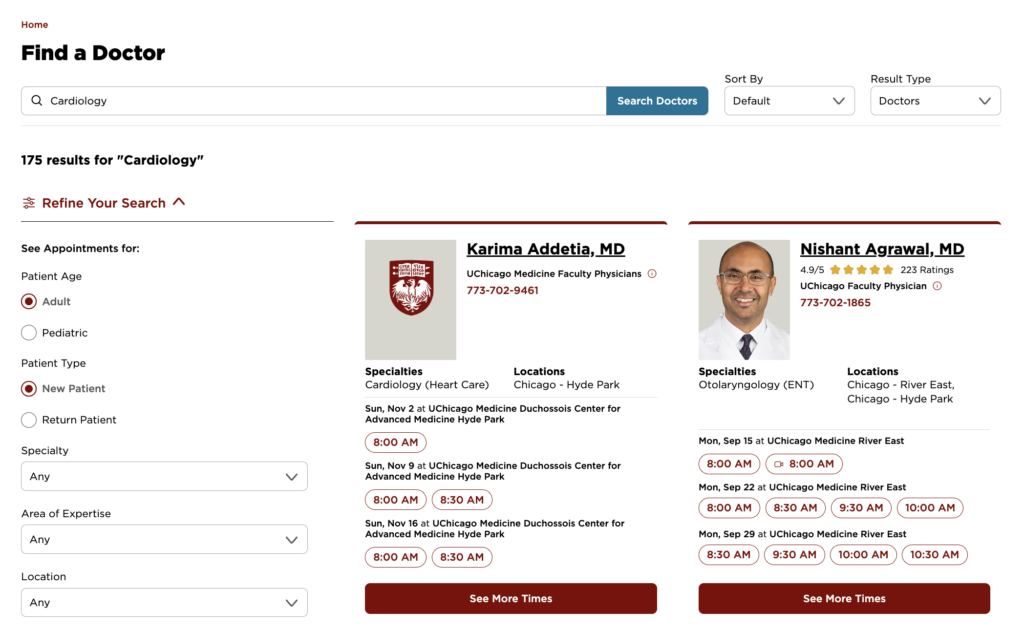
For example, we often hear about provider search failures. A patient types “heart doctor” into a site that only recognizes “cardiologist.” The result is a zero-result query. Without the right AI-backed search technology or careful tuning, the patient believes the system doesn’t have what they need and clicks away to a competitor. Multiply that by thousands of patients each month and the impact becomes staggering.
"Patients do not compare your digital experience to the hospital across town, they compare it to Amazon, Netflix and Google. In that world, clunky or invisible search is not just an inconvenience; it’s a liability."
Onsite Search Reveals Patient Intent
Search is more than a way to navigate a website; it’s one of the clearest signals of patient intent available to healthcare marketers.
Every search represents a question, a need or a next step in a patient’s journey. Someone searching for “orthopedic surgeon,” “MRI scheduling” or “knee replacement recovery” is telling you exactly what they hope to accomplish.
The challenge is that most health systems never use this data beyond helping someone find a page.
When marketing teams begin treating search behavior as customer intelligence, everything changes. Search data exposes content gaps, uncovers new patient needs, validates campaign performance and helps prioritize digital investments based on what patients are actually trying to accomplish.
The organizations seeing the greatest digital success are learning from every search to continuously improve patient access and the entire digital experience.
What Product Thinking Looks Like
The mindset shift is simple but powerful: stop thinking of onsite search as a website feature and start treating it like a living, breathing digital product. Like every other digital product, it should have an owner, measurable outcomes, ongoing optimization and a roadmap informed by patient behavior.
Treating search like a product means:
- Ownership: Assigning clear responsibility within marketing or digital teams for the ongoing performance of search.
- Optimization: Continuously tuning results, improving relevance and eliminating dead ends.
- Iteration: Using real-world data to refine search, test improvements and roll out updates.
- Enablement: Empowering non-technical teams to adjust search without waiting on backend development cycles.
This is how leading health systems approach every other core digital product, and search should be no different.
At SearchStax, we often see the transformation once marketing teams take ownership. For example, a health system that was previously dependent on IT for every small change can suddenly improve provider findability themselves. Marketing teams gain the agility to respond to patient demand without waiting weeks or months for developer support. That shift is not just operationally efficient, it directly impacts patient satisfaction and access to care.
Metrics That Matter
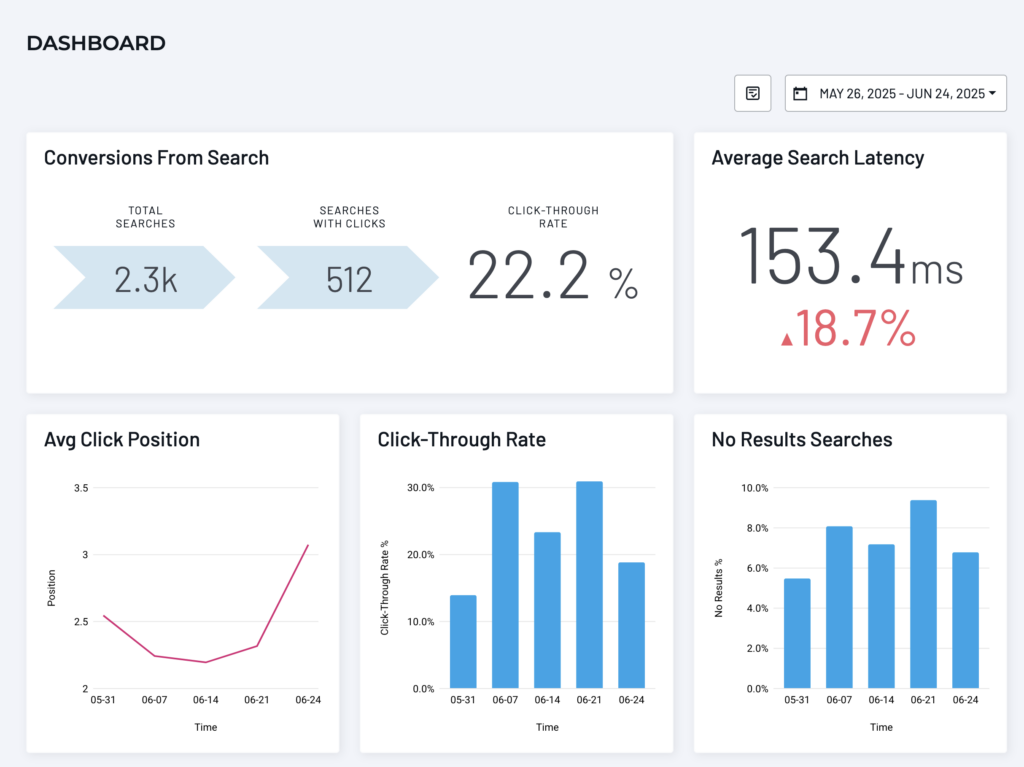
Product thinking also requires measurement. With the right tools, health systems can track where patients succeed and where they get stuck. The most important metrics include:
- Search-to-click-through rate (CTR): Are patients engaging with the results they see and clicking through the resource page? A measure of search relevance, understanding of intent and impact of promoted content.
- Zero-result queries: How often do patients search for something and come up empty? A measure of how well your site is delivering desired content and reveals content gaps.
- Refinement rate: How often do patients have to retype or adjust their query to get what they need? A measure of how quickly users can find what they need and how well tuned your search results are to inbound search intent.
- Post-search behavior: Do searches lead to meaningful actions such as viewing provider profiles, starting a scheduling flow or accessing health content? A measure of downstream impact on core engagement and conversion stats.
Each of these metrics offers a direct line of sight into patient friction points and a roadmap for removing them. A rise in zero-result queries tells you patients are not using the same language as your content. A low click-through rate signals that results might be poorly ranked. High refinement rates show where search is not delivering on the first try.
Modern platforms like SearchStax Site Search make these insights accessible to marketing and digital teams without requiring SQL queries or custom dashboards. That visibility allows teams to go from guessing to knowing, and from reacting to proactively improving the patient journey with a level of marketing agility that cuts out the need for IT tickets and lengthy development cycles.
What Happens When Site Search Works
It’s easy to talk about the costs of poor search, but it is just as important to understand the benefits when it works well.
Our healthcare consumer research reinforces why this matters. Four out of five patients told us a better healthcare website would increase their confidence in a provider. Site search is often the moment where that confidence is either strengthened or lost. When patients quickly discover the right information, providers and services, digital experiences become a competitive advantage rather than a source of friction.
When patients quickly find the right provider, service line, or location, the impact is felt across the organization:
- Patient access improves. A successful search leads directly to scheduling, whether that is an online appointment, a call with the right department or a referral to the right specialty.
- Call center volumes decrease. Every question answered through search is one fewer call to handle, which reduces costs and improves staff productivity.
- Marketing performance strengthens. When patients can discover and engage with content, the impact of every campaign, email and ad spend increases.
- Trust is reinforced. A health system that delivers answers quickly online earns credibility and confidence, which translates into stronger patient relationships.
One academic medical center using SearchStax recently uncovered through analytics that patients were consistently searching for “parking validation.” The phrase didn’t exist in their website content. Once they created and indexed a simple informational page, those queries turned into successful results, patient confusion decreased and calls to the help desk dropped noticeably. This is the kind of small but meaningful win that only comes from treating search like a product.
The Time to Improve Patient Access is Now
The urgency could not be higher. Health systems are currently navigating Medicaid churn, pressure to reduce costs and rising expectations for digital access. Patients judge whether your organization understands their needs before they ever schedule an appointment
In that world, clunky or invisible search is not just an inconvenience; it’s a liability. The health systems that treat search like a product will see fewer support calls, better provider discovery and stronger engagement across their digital channels. Those that ignore onsite search will keep losing patients at the front door.
Better Onsite Search For Health Systems Starts Here
It’s time to stop treating onsite search as a website feature and start recognizing it as a strategic digital product. Every search represents patient intent, revealing what people need, where experiences fall short and how your digital front door can better connect patients to the information and care they’re seeking.
At SearchStax, we help health systems transform search from a forgotten utility into a measurable driver of patient engagement. Our Site Search Solution and AI-powered tools like Smart Answers give marketing leaders the visibility, control and agility to continuously optimize search, uncover patient insights and improve digital experiences.
If you’re ready to transform search into a strategic advantage for your organization, we’d love to show you what is possible.

Get Our Newsletter
The Stack is delivered bi-monthly with industry trends, insights, products and more

Chris Pace
|
VP, Digital Experience Strategy
Chris Pace is VP, Digital Experience Strategy at SearchStax, where he helps enterprises modernize digital access through smarter site search and self-service. He brings 15+ years of marketing leadership focused on connecting people to valuable digital experiences.