 Optimizely



Designing Smarter Search Experiences with Practical AI
The AI Hype vs. Reality: A Practical Approach to AI
What comes to mind when you think of artificial intelligence (AI)? Chatbots answering questions? A future where machines make decisions for us? AI is everywhere, evolving at a blistering pace – but nowhere is its impact more critical than in search. As the primary way people interact with digital experiences, search has become the battleground where AI can either amplify or erode trust. But as the hype continues to build, the real question is: Are we applying AI in ways that truly create value?
At SearchStax, we believe AI should be practical – enhancing human decision-making rather than replacing it. We’ve seen firsthand how businesses struggle with AI that overpromises and underdelivers, often lacking the context and control that real-world applications demand. That’s why we take a Practical AI approach: blending cutting-edge AI models with human expertise and curation to deliver search experiences that are not only intelligent but also trustworthy and actionable.
For website search, that means applying AI where it can make a measurable difference: helping people find the right content faster, giving digital teams the tools to continuously improve relevance and turning search data into a signal of what audiences need. Practical AI isn’t AI for AI’s sake. It’s AI designed to improve discovery, engagement and trust across the digital experience.
What is Practical AI?
Practical AI is about creating business value through AI that is efficient, accessible and empowering. It’s AI that works with people, not instead of them. In the world of search, that means providing AI-powered enhancements while giving website owners the ability to fine-tune search results for accuracy and relevance.
In simple terms, Practical AI applies artificial intelligence to solve real problems while preserving the context, control and human expertise needed to produce trustworthy outcomes.
That’s the key difference between SearchStax’s AI-powered search and tools like ChatGPT, which automatically generate responses based on trained data. While generative AI can be impressive, it often lacks contextual awareness, requiring human oversight to ensure accuracy and appropriateness. Practical AI ensures that the right combination of automation and control leads to better business outcomes.
At SearchStax, this approach is built on three core principles:
- AI-Driven Enhancements – Leveraging natural language processing (NLP), machine learning (ML), and Generative AI to improve not just the relevance of search results—but the entire search journey, from the first keystroke to content discovery.
- Human Control – Ensuring marketing and digital teams retain control over how search results are adjusted and presented.
- Proven Search Technology – Leveraging over a decade of expertise in site search to create trusted, scalable solutions.
The result? A unique blend of AI-enhanced efficiency with human-guided accuracy, delivering search experiences that users can trust.
"The highest value from AI comes when those who know their industry, business and audience best can use it to make smarter, faster decisions."
Why Practical AI Matters for Site Search
Search has become the front door to digital experiences. It’s how people find information, navigate content and make decisions—especially in industries where trust is paramount.
It’s also one of the clearest expressions of intent on a website. When someone searches, they are telling you, in their own words, what they need. Practical AI can help organizations understand that intent and connect each visitor with the most relevant content or next step.
For businesses, delivering an intuitive, relevant and fast search experience is no longer a luxury—it’s an expectation. However, leaving search results entirely to AI can create risks, from misinformation to poor user experiences. That’s why our approach ensures that AI assists rather than dictates, keeping human expertise at the center of the equation.
The goal stretches beyond simply adding AI to site search; it’s about using AI to make the search experience more useful for visitors and more actionable for the marketing and digital teams responsible for it.
Let’s take a look at industries where search accuracy directly impacts trust and outcomes:
Higher Education: Helping Students Find the Right Information
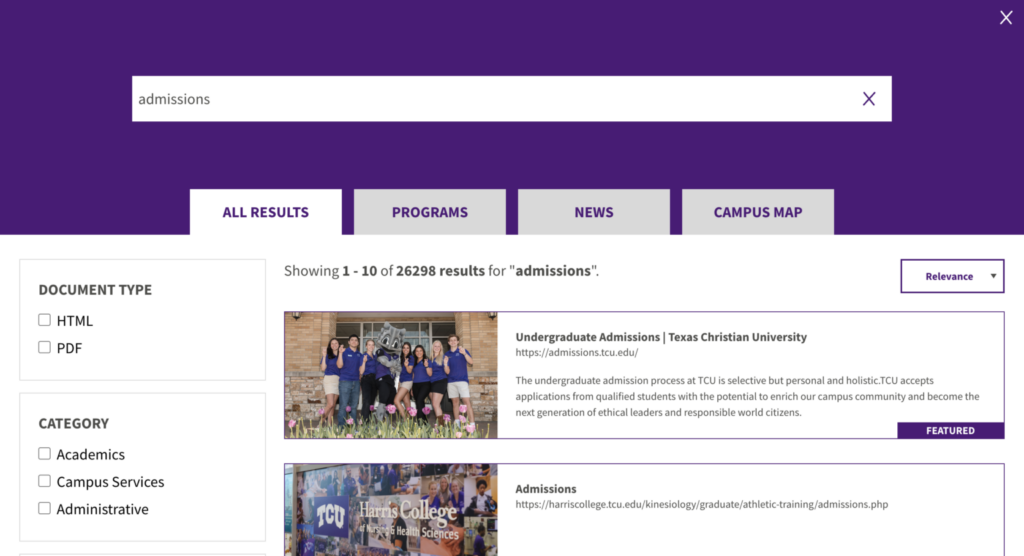
Universities serve a diverse audience—prospective students, current students, faculty, alumni and donors. Each group searches for different information, from admissions to course catalogs to funding opportunities. Yet, many university search engines fail to provide relevant, up-to-date results, frustrating users and leading to missed opportunities.
Healthcare: Delivering Trusted Information When It Matters
For healthcare websites, access to precise, trustworthy information is non-negotiable. Patients searching for symptoms, conditions or providers need information vetted by experts, not just what an AI model deems relevant. In an industry where misinformation can have serious consequences, Practical AI ensures that doctors, researchers and content managers retain control over search outcomes.

Government: Connecting Communities with Trusted Information
Government websites must serve citizens with accurate, up-to-date information—from local services to policy changes. AI can assist in surfacing content efficiently, but humans must have the ability to update and refine search results as regulations, community needs and events evolve.

From Searching for Links to Asking for Answers
There’s another important shift happening in search: generative AI and answer engines have conditioned us to ask complete questions and expect useful answers, not just a page of links we have to investigate ourselves.
That expectation doesn’t disappear when someone arrives on a website. In fact, it becomes even more important. Visitors who reach your site may already have done significant research elsewhere. They arrive with more specific questions and expect your digital experience to understand their intent and help them move forward quickly.
This is where Practical AI can move site search beyond simply retrieving documents. Search experiences can combine traditional results with direct, generative answers grounded in an organization’s own website content. With SearchStax Smart Answers, for example, visitors can ask natural-language questions and receive concise answers based on the content an organization already trusts—while still providing a path back to the underlying source material.
The objective is to deliver an answer grounded in the right content, within the context of the organization’s digital experience. This is Practical AI applied to answer experiences: using generative AI to reduce the distance between a visitor’s question and the information they need, without giving up the trust and control that enterprises require.
And for digital teams, these interactions create something equally valuable: a clearer view into audience intent. The questions visitors ask can reveal content gaps, emerging needs and opportunities to improve the broader website experience. Search becomes a continuous feedback loop between your audience and your organization.
The Future of Practical AI in Search
As AI adoption accelerates, many industries are realizing that unchecked automation can create blind spots. At SearchStax, we believe the future of AI-powered search isn’t about removing human input—it’s about amplifying human expertise< with intelligent automation.
It’s also about recognizing that search itself is evolving. The search box is no longer simply a utility for retrieving pages. It can become an intelligent layer across the website that understands intent, connects people with relevant answers and gives organizations insight into what their audiences need.
Looking ahead, we’re focused on expanding AI’s ability to empower site owners with deeper insights, predictive analytics and automated optimizations that maintain compliance and human oversight where it matters most. Our next phase of Practical AI will bring even more personalization and efficiency to digital teams, ensuring search delivers real business impact without sacrificing trust.
For marketers and digital teams, the opportunity is particularly powerful; AI can help them understand audience intent and continuously shape the search experience without making every improvement dependent on developers or IT. For developers, it means a scalable search foundation that can support increasingly intelligent experiences without requiring teams to build every AI capability from scratch.
Because at the end of the day, AI isn’t just about making things faster—it’s about making them smarter, in ways that truly serve the people using them.
Practical AI: Making AI Work for You
The highest value from AI comes when those who know their industry, business and audience best can use it to make smarter, faster decisions. That’s what Practical AI is all about – giving brand owners, marketers and digital teams the power to shape search experiences, rather than relying on black-box automation.
Search is no longer just a utility – it’s a strategic asset. It’s the first impression, the conversion engine, and often the difference between engagement and frustration. That’s why Practical AI for search isn’t just smart – it’s essential. As external discovery changes and visitors increasingly expect direct answers, the search experience on your own website becomes even more important. Every search is an opportunity to understand intent, connect someone with the right information and help them take their next step.
As we continue to innovate, our goal is simple: Make AI work for you, not the other way around. Use it to make trusted content easier to discover. Use it to answer questions more naturally. Use it to understand what your audience needs. And give the people who know that audience best the control to keep making the experience better. And that’s the future we’re building at SearchStax.

Get Our Newsletter
The Stack is delivered bi-monthly with industry trends, insights, products and more

Sameer Maggon
|
Founder & CEO
Founder & CEO of SearchStax, building an AI-powered Search Experience Platform that helps organizations improve findability, conversion, and self-service. 20+ years in enterprise search and cloud platforms.