 Optimizely

AI search is not just changing how people find websites. It is changing what people expect from websites once they arrive.
As generative engines answer more questions directly, brands will likely see fewer casual visits from traditional search. But the visitors who do click through from AI-generated answers are often more informed, more qualified and closer to conversion.
The new challenge for marketing and UX teams is no longer just ranking in search results. It’s becoming the source that AI systems trust, cite and recommend. That requires a shift from SEO-first content toward Generative Engine Optimization (GEO): content structured for both humans and machines.
It also requires a shift in website experience. If users are becoming accustomed to asking full questions, refining answers and navigating through AI-guided conversations, then AI search should become a first-class website navigation pattern.
From Search Rankings to AI Citations
For two decades, digital discovery was shaped by the “ten blue links” model. Marketers optimized pages to rank, users clicked through and websites captured attention, leads and attribution. Generative AI is breaking that pattern.
AI answer engines now summarize, compare and recommend inside the search experience itself. That means more zero-click journeys, where users get what they need without visiting a website. Google zero-click searches hit 68% in early 2026. (Search Engine Land). SparkToro’s zero-click research already shows how much search activity has ended without an open-web click in the last 2 years (SparkToro).
For marketers, that sounds threatening. Less traffic usually means fewer leads. But AI search introduces a more nuanced reality: lower volume, higher intent.
"People are becoming more comfortable asking complete questions instead of typing fragmented keywords. They expect search experiences to understand context, compare options, summarize trade-offs and guide them toward the next best action."
Why AI Referrals Can Convert Better
When users ask ChatGPT, Perplexity, Copilot or Gemini to help them research a product or solve a problem, much of the early buyer journey happens inside the AI conversation. The user compares options, refines criteria, asks follow-up questions and narrows the field before ever clicking a link.
By the time they do click, they are often past casual exploration. They are validating, pricing, comparing or preparing to act.
That is the core idea behind intent compression. AI collapses multiple research sessions into one guided interaction. The website visit becomes less of a first touch and more of a high-intent handoff.
Several early studies point in this direction. Ahrefs reported that AI search traffic represented a tiny share of visits but drove a much larger share of product signups (Ahrefs). Microsoft Clarity found that AI traffic converted at meaningfully higher rates across publisher and news domains (Microsoft Clarity). Adobe has also reported rapid growth in AI-driven referral traffic as consumers use generative tools for research, shopping and comparison (Adobe).
The implication is clear: marketers need to stop treating all traffic loss as pipeline loss. The more important question is whether the brand is visible, cited and trusted inside AI-generated answers.
GEO is an Extension of SEO
Generative Engine Optimization is a nuanced form of SEO. SEO has historically rewarded backlinks, keyword relevance, domain authority, and page-level ranking signals. GEO still takes these factors into account, but also focuses on rewarding extractable truth.
AI systems need content they can parse, verify, and safely synthesize. That means pages should be structured around clear claims, evidence, entities and relationships. The Princeton-led GEO research showed that tactics such as adding statistics, expert quotations, citations and fluent language can improve visibility in generative responses, while keyword stuffing can actively hurt performance (arXiv GEO paper).
For content teams, this requires a sharpening of focus for ensuring content appeals to generative engines. Generic thought leadership will become less useful. AI can summarize generic content without needing to cite it. What it can’t easily replace is original research, proprietary data, expert analysis, first-party benchmarks, customer patterns and precise product information.
In the AI search era, originality becomes the moat.
UX Needs to Serve Two Audiences
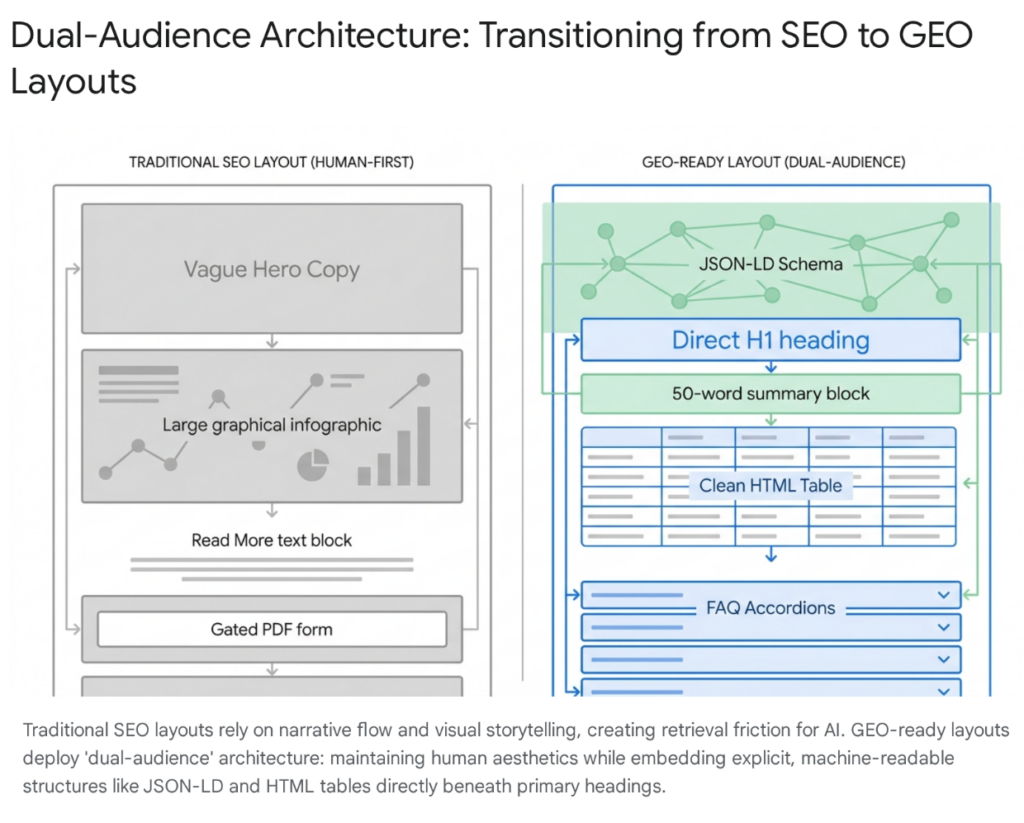
The next evolution of website UX is dual-audience architecture. A page must still be useful, persuasive and easy for humans to navigate. But it must also be legible to AI crawlers.
That means critical information can’t live only inside images, PDFs, complex JavaScript components or gated assets. If the answer is hidden behind a form, the AI can’t cite it. If a comparison table is embedded as a graphic, the AI may not understand it. If the hero copy is clever but vague, the model may not know what the company actually does.
A GEO-ready page should lead with a direct answer, use descriptive headings, expose key facts in HTML, include comparison tables, provide FAQ content and support the page with JSON-LD schema. BrightEdge has written about structured data’s growing importance in AI search visibility (BrightEdge).
AI Search Should Become a Website Navigation Pattern
There’s another UX implication that goes beyond content structure: if the user’s mental model has changed, the interface should change with it.
People are becoming more comfortable asking complete questions instead of typing fragmented keywords. They expect search experiences to understand context, compare options, summarize trade-offs and guide them toward the next best action. That expectation won’t stop at Google, ChatGPT, Perplexity or Copilot. Users will increasingly bring the same behavior to brand websites.
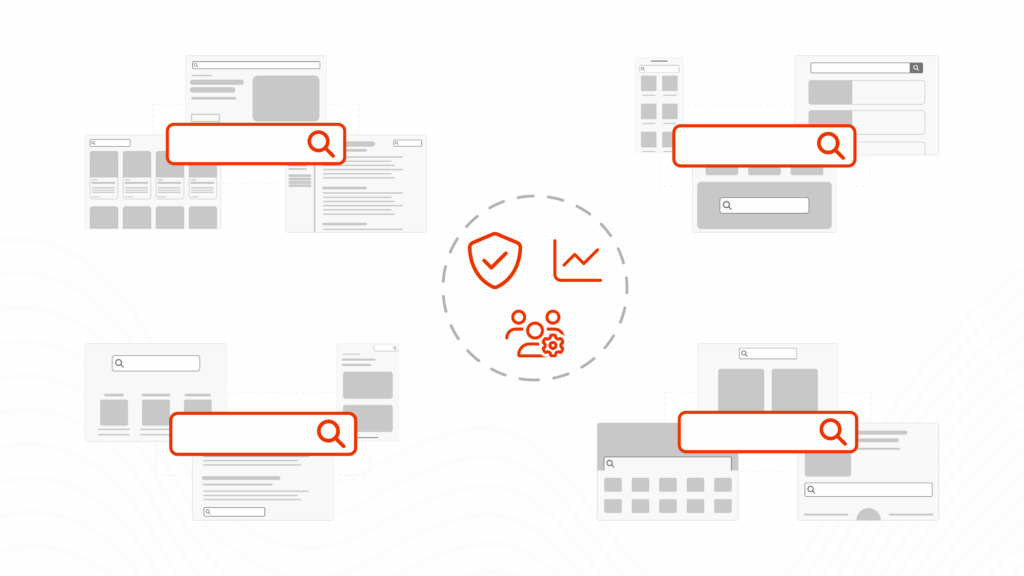
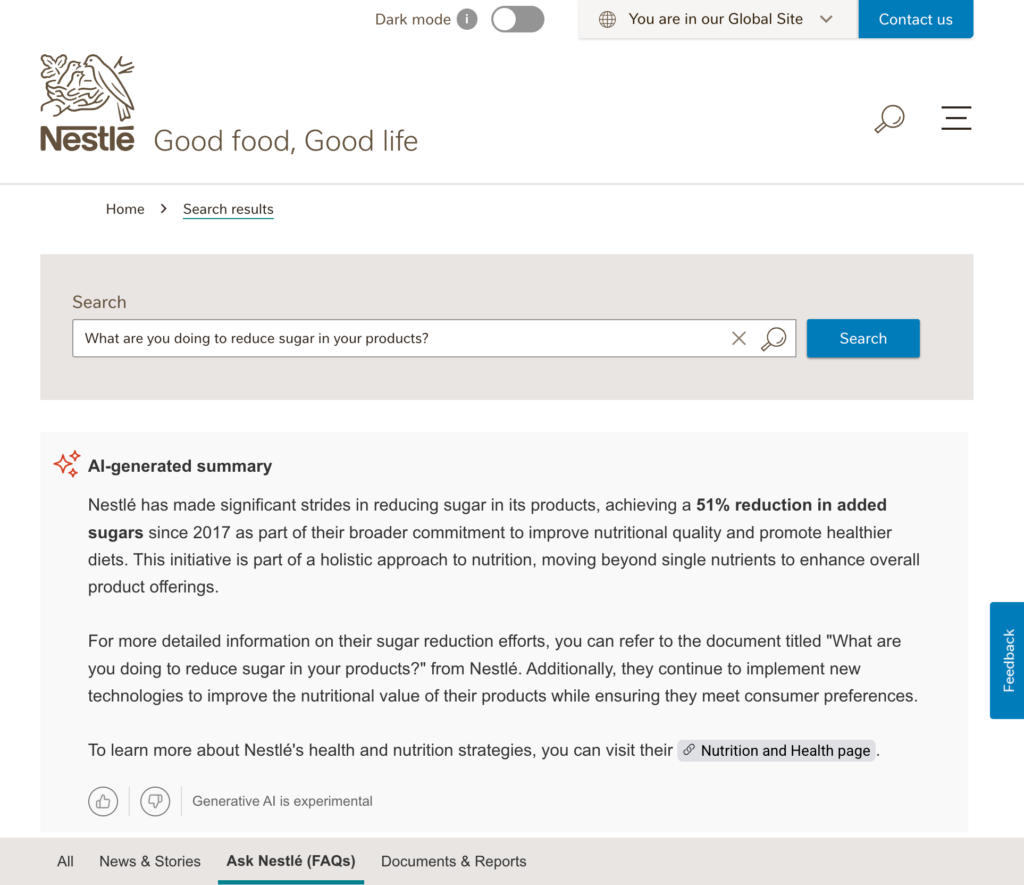
This creates an opportunity to rethink site search as an AI-powered navigation layer. Instead of forcing visitors to interpret menus or guess the right keyword, websites can offer an experience that works like a guided concierge.
A visitor should be able to ask, “Which plan is right for a multi-region deployment?” or, “How does this compare to self-hosting?” and receive a grounded answer drawn from the company’s own approved content. The best version of this experience doesn’t replace navigation, product pages or support content. It connects them.
For marketers, AI search can become a better conversion path. For UX teams, it reduces friction and supports task completion. For buyers, it mirrors the way they now research everywhere else: through questions, summaries, comparisons and recommendations.
In this model, AI search isn’t just a support feature or a search box upgrade. It becomes a primary pattern for navigating the modern website.
Rethinking Gated Content
Traditional B2B demand generation often puts the best material behind a form: research reports, architecture diagrams, benchmarks, and technical guides. That model creates a problem for AI discovery.
If a model can’t access the content, the brand may disappear from the answer.
The better approach is hybrid ungating. Keep the full asset gated if it is valuable for lead capture, but publish the essential facts openly: the executive summary, key statistics, diagrams with descriptive text, methodology, FAQs and comparison points. Give AI systems enough context to cite the brand, then give human visitors a reason to convert.
The New Playbook
The brands that win in AI search won’t be the ones publishing the most content. They’ll be the ones publishing the most useful and verifiable content.
For marketers, that means shifting measurement from rankings and sessions toward citation frequency, AI referral quality, assisted conversions and share of model. For UX teams, it means designing pages where the human experience, machine-readable structure and AI-guided navigation reinforce each other.
AI search rewards brands that are easy to understand, easy to cite and easy to navigate.
Get Our Newsletter
The Stack is delivered bi-monthly with industry trends, insights, products and more

JF Boisvert
|
Director, Product Design & UX
Director of Product Design & UX at SearchStax, focused on AI-powered search experiences, usability, and conversion-driven design for modern digital platforms.