 Optimizely



Sixty percent of patients report major frustrations with onsite search on healthcare websites. Not minor annoyances. Major frustrations, at the exact moment they’re trying to take action.
That finding from the 2026 SearchStax and MDRG national study deserves more attention than it typically gets in digital strategy conversations. Search isn’t a secondary feature buried in the navigation. For patients trying to move from concern to care inside a complex health system, it’s often the primary pathway. When it breaks, everything downstream breaks with it.
Read on below to understand about the impact of subpar search experiences on health system websites, or you can dive into the full research findings by downloading the full report.

Search Is Where Patient Intent Becomes Action
Patients don’t arrive on health system websites in a neutral state. Someone typing into a search bar has already decided to take action. They’ve moved past awareness and they’re trying to find a specific provider, understand a diagnosis, confirm insurance coverage or book an appointment. That’s a fundamentally different posture than a page visitor reading content.
The research is specific about how patients actually search. Natural language. Partial terms. Symptom-based queries.
“Heart doctor near me.”
“Do I need surgery for a torn meniscus?”
“Pediatric allergist taking new patients.”
Nobody is typing the clinical terminology that lives inside most health system content management systems. Nobody is searching the service line name that an internal planning committee agreed on three years ago.
This matters because search users are the highest-intent visitors on the site. They’ve self-selected into action mode. Getting the experience right for that group has an outsized effect on conversion compared to almost any other digital investment a health system can make.
"When search fails, patients don't wait around to try a different approach. Seventy-one percent of patients who experience search frustration leave the site or turn to outside sources."
What Frustration Actually Looks Like
The MDRG qualitative interviews put a human face on what the 60% statistic actually represents. A 51-year-old woman described searching for “pediatric doctor” on a health system website and getting locations, doctors, articles and newsletters all returned together with no clear way to distinguish between them. Her conclusion: she had to figure out what she was actually looking for on her own. That’s not a search experience; that’s an obstacle.
A 59-year-old woman described a pattern that will be familiar to anyone who has watched usability testing on healthcare search. She types something in. No results. She tries an abbreviation. No results. Then she picks up the phone.
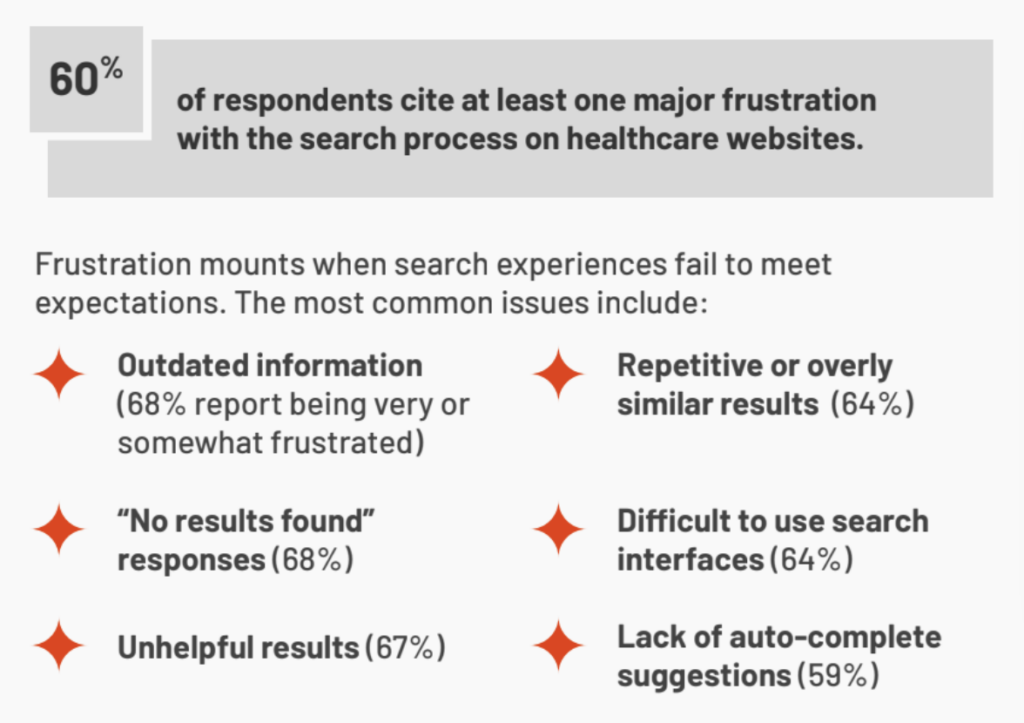
These aren’t edge cases from unusually difficult users. The breakdown data from the study shows exactly where search falls apart consistently. Outdated information frustrates 68% of patients. “No results found” responses frustrate 68%. Unhelpful results frustrate 67%. Difficult search interfaces and repetitive results each frustrate 64%. Lack of autocomplete suggestions frustrates 59%.
Every one of those failure modes is a solvable problem. Most health systems haven’t solved them because search has historically been treated as a utility rather than a conversion-critical experience.
This excerpt from the research report tells the full frustration story:
The Breaking Point: When Patients Give Up
When search fails, patients don’t wait around to try a different approach. Seventy-one percent of patients who experience search frustration leave the site or turn to outside sources. That number should stop people in their tracks.
Think about what that population represents. These are patients who came to the website with intent. They identified search as their fastest path to what they needed. The experience failed them at the highest-intent moment in their digital journey, and the majority of them left. Some went to a competitor’s website. Some went to Google. Some went to a telehealth platform that answered their question in 30 seconds. A meaningful share of them never came back.
The patients most likely to convert are the ones most likely to leave when search breaks. That’s the part of this equation that rarely surfaces in how health systems prioritize their digital investment.
Why Traditional Search Approaches Fall Short
Most health system search tools were built around keyword matching. A patient types a word, the system looks for that exact word in indexed content and returns whatever matches. The problem is that patients don’t search in keywords. They search in questions, symptoms and conversational phrases that often have no direct match to how clinical content was written or tagged.
“Back pain” should surface spine specialists, relevant service lines, scheduling options and location-based results. On most health system websites, the search bar returns a mix of blog posts, PDF forms, physician bios that mention back pain in passing and service line pages written for SEO rather than for a patient in discomfort at 10pm. The intent behind the query and the results returned are operating in completely different registers.
Static search infrastructure compounds the problem. Patient needs are dynamic. Someone searching in January after a ski injury has different urgency than someone researching a chronic condition over several months. Search experiences that can’t adapt to behavioral signals, refine results based on what patients actually click and learn from query patterns over time are permanently behind where patient expectations have already moved.
The gap between what patients type and what health system search returns isn’t a content problem. It’s an infrastructure problem. Content strategy can close part of it. The underlying search architecture has to be capable of interpreting intent, handling natural language and surfacing the right result even when the query doesn’t match any exact term in the index.
Reframing Search as a Strategic Lever
Search is not a site feature. It’s a conversion engine, and most health systems are running it at a fraction of its potential.
When search works the way patients expect, the effect is immediate. The right provider surfaces with availability visible. The right service line appears with a clear next step. The right answer to a symptom question leads directly to a scheduling pathway rather than a dead end. Confidence builds. The patient moves forward. That sequence, from query to action, is what effective search infrastructure makes possible at scale.
When search fails, it doesn’t just create a bad experience. It breaks the patient journey at the moment the patient was most ready to move. Recovering that patient after they’ve left is significantly harder and more expensive than getting the search experience right the first time.
What Healthcare Teams Should Do Next
The starting point isn’t a platform decision. It’s a diagnostic one. Pull your search query logs and look at what patients are actually typing. The volume of zero-result queries, the drop-off between search and next action and the queries that return results patients clearly don’t find useful will tell you more about where the experience is breaking than any amount of stakeholder feedback.
From there, the work is about closing the gap between patient language and system content. That means tagging and structuring content around symptom-based and natural language queries, not just clinical terminology. It means building autocomplete that reflects how patients actually search rather than surfacing internal nomenclature. And it means treating search result quality as something that requires ongoing attention and tuning rather than a one-time configuration.
Health systems that get this right aren’t just improving a website feature. They’re creating a direct line between patient intent and patient access, and that’s where digital experience starts to move the numbers that actually matter to the organization.
Explore the Full Findings On How Search Impacts Patient Behavior
Download the 2026 “Win or Lose Patients at the Digital Front Door” report from SearchStax and MDRG.


Chris Pace
|
VP, Digital Experience Strategy
Chris Pace is VP, Digital Experience Strategy at SearchStax, where he helps enterprises modernize digital access through smarter site search and self-service. He brings 15+ years of marketing leadership focused on connecting people to valuable digital experiences.