

 Optimizely


Higher Education Website Search Is Broken. Is It Costing You Students?
93% of prospective students rely on college websites to make enrollment decisions, yet only 19% of higher ed professionals believe their site delivers a strong experience.
Research conducted in collaboration with the Chronicle of Higher Education surveyed 225+ website and digital experience professionals to reveal why site search consistently lets current and prospective students down. Your search bar holds more power than you think. Explore the findings and see what fellow institutions are doing to improve.
Why Higher Education Websites Still Fall Short: The Case for Search
College websites now shape nearly every stage of the student journey; 93 percent of high-school students rely on them while deciding where to apply. Yet many run into confusing navigation and missing information at a moment when colleges can least afford friction, given stagnant enrollment and shrinking recruitment pipelines. Current students also depend on these sites for crucial services such as advising, tutoring, mental-health support and career resources, which raises the stakes for clarity and accuracy.
Inside institutions, confidence in web performance is low. Only 19 percent of higher-education professionals say their site delivers a strong experience, and just 14 percent believe their search tool consistently points users to current information. Irregular content updates and long delays before new information appears in search compound the issue, especially within sprawling ecosystems where each department manages its own silo of pages. These shortcomings also point to an opportunity: better search tools and stronger analytics could transform institutional websites into reliable digital entry points. Yet 59 percent of survey respondents don’t track how many visitors use site search, limiting their ability to make meaningful improvements.
Why Higher Education Websites Still Fall Short: The Case for Search
Only 19 percent of higher-education professionals say their site delivers a strong experience.
Only 19 percent of higher-education professionals say their site delivers a strong experience.
59 percent of survey respondents don’t track how many visitors use site search, limiting their ability to make meaningful improvements.
59 percent of survey respondents don’t track how many visitors use site search, limiting their ability to make meaningful improvements.
Models to Emulate: What Better Site Search Looks Like
50%
50% of respondents recognize that their search frustrates users with irrelevant or outdated results.
49%
49% of respondents cite outdated content as a likely search frustration.

Models to Emulate: What Better Site Search Looks Like
Better site search is less about technology than priorities. Organizations that succeed tend to treat search as a product, with clear ownership of the user experience and the mandate to use analytics to keep results relevant and responsive to real-world changes.
Nashville.gov shows what that can look like at scale: with more than 20,000 pages and 10,000 documents spread across 60 departments, 30 to 40 percent of visitors head straight to the search bar, and the city continuously tunes results using machine learning, “no results” monitoring and seasonal adjustments. Higher ed teams are applying similar playbooks. At Texas Christian University, search analytics and result “promotions” help direct users away from outdated pages and toward the most authoritative answers; that matters because 50 percent of survey respondents cite irrelevant results as a common frustration, and 49 percent point to outdated content, even as 68 percent say relevant search results are extremely important to a positive website experience.
The Analytics Blind Spot: Why Colleges Aren’t Learning From Site Search
Many colleges measure their websites, but far fewer learn from how visitors search. 47 percent of survey respondents said they either don’t use onsite search data or don’t have access to it, and fewer than one-third use it to inform content strategy; institutions are also far more likely to rely on Google Analytics than on internal search insights. That leaves a critical blind spot: Google Analytics can explain what is happening in aggregate, but onsite search reveals what students are trying to find, right now.
The survey suggests most campuses are missing that signal. Sixty-four percent don’t track top search terms, 72 percent don’t track “no results” searches and 52 percent are unsure how engaged search users are. Survey findings also reveal that departments that most need this visibility feel the impact most directly. Admissions, enrollment and student-services teams depend on timely, accurate information, yet they can’t easily see where students are getting stuck; student-services staff are especially hungry for top-term insights, but 85 percent say they don’t track them.
When search data is used, it most commonly drives updates to admissions content, followed by events/news and program details. Despite this, survey findings suggest the most significant, yet often overlooked opportunity is turning dead ends and emerging queries into faster, search-visible fixes.
The Analytics Blind Spot: Why Colleges Aren’t Learning From Site Search
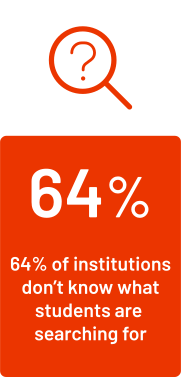
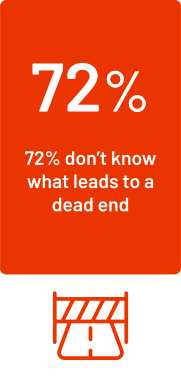
This denotes a massive gap in content strategy.
Marketing Agility Starts With Search Ownership




3%
Only 3% of respondents said that marketing has full control over making adjustments to their onsite search, showing a need for more agility.
30%
30% recognize that if marketing has control over making search adjustments, they could respond faster to visitor needs.
Marketing Agility Starts With Search Ownership
Marketing agility refers to an organization’s ability to quickly pivot and respond appropriately to unexpected market forces. A great example of this is how Texas Christian University’s web team treats onsite search like a channel that can be tuned in real time. When analytics reveal a shift in what visitors need, the team makes same-day adjustments; that agility keeps the site aligned with the questions students and families are asking right now.
The survey shows most institutions cannot move that quickly. A quarter of respondents say search adjustments take longer than a week, only 3 percent say marketers can make changes directly and just 31 percent report that marketing has full control over optimizing search. Yet respondents recognize the upside: 30 percent believe marketing control would speed responses to visitor needs, and 25 percent say it would boost innovation and experimentation. The institutions that shorten the distance between insight and action are the ones best positioned to keep pace with fast-changing student needs.
AI in Site Search: Cautious Adoption, Clear Demand
AI in onsite search is not yet mainstream in higher education, but momentum is building. The survey found that 84 percent of respondents either do not use AI at all or only use early-stage AI in limited ways; at the same time, 72 percent say they expect to advocate for more AI tools to improve website experiences within the next two years. Institutions are approaching AI with elevated expectations. Trust, transparency, privacy and proven outcomes matter more than novelty.
When administrators do lean in, they want AI to improve what users feel immediately: content recommendations, personalization and better relevance in search, along with predictive analytics and chatbots. Early examples point to a pragmatic model, where AI suggests and humans decide. Grand Valley State University uses AI to draft page summaries that creators can approve or revise, helping improve search click-through; Texas Christian University reports gains after adopting AI-assisted features, including improved result positioning and higher click-through. The message from the field is consistent: AI works best when it’s controlled, measurable and clearly in service of the student experience.
AI in Site Search: Cautious Adoption, Clear Demand
84% aren’t using AI yet or only use early-stage AI in limited ways
84% aren’t using AI yet or only use early-stage AI in limited ways
72% plan to advocate for more AI tools in the next two years
72% plan to advocate for more AI tools in the next two years

About the Chronicle of Higher Education
The Chronicle of Higher Education is academe’s most trusted resource for independent journalism, career development, and forward-looking intelligence. Since its founding in 1966, The Chronicle has grown to serve millions of educators, administrators, researchers, and policymakers who rely on its insights to lead, teach, learn, and innovate. The Chronicle’s independent newsroom – the nation’s largest dedicated to covering colleges and universities – is home to award-winning journalists and data analysts with a passion for serving audiences with indispensable news and actionable insights on issues that matter.