 Optimizely



There’s a moment that happens on every website that most teams overlook. A visitor lands on your site; they don’t click around your navigation, and they don’t take time to scan headlines on your homepage. Instead, they go straight to the search bar and type exactly what they want.
This eliminates guess work and ambiguity. It’s a direct line of insight into visitor intent.
And yet, for something so direct and so rich with valuable signals, site search remains one of the most underutilized assets in enterprise digital strategy.
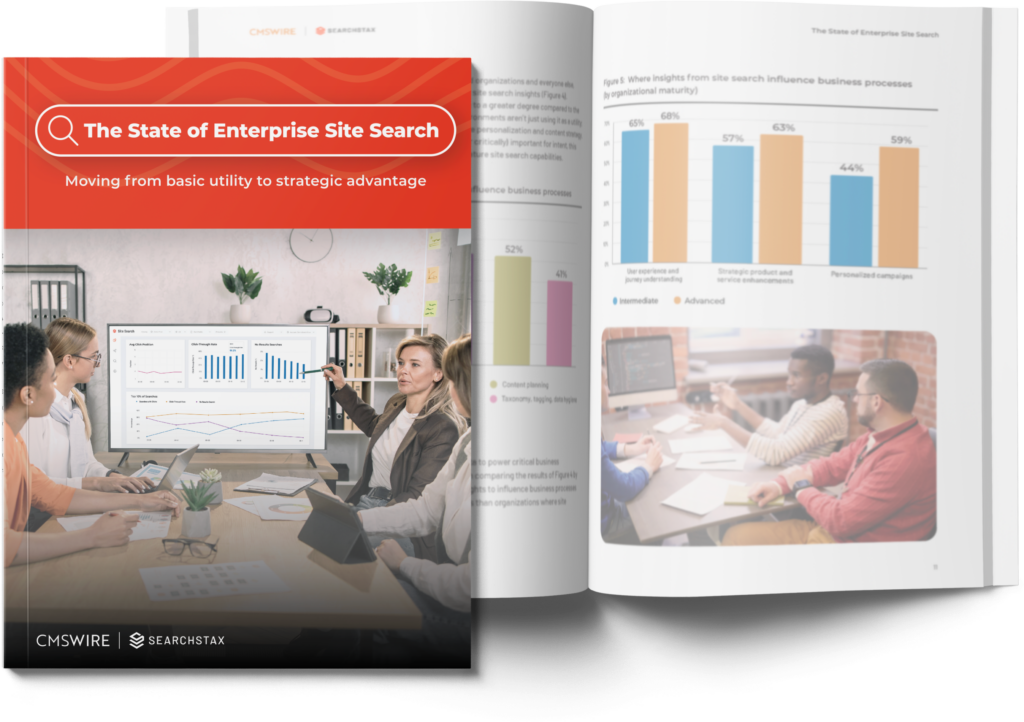
Our latest research with CMSWire revealed that while 82% of organizations say site search data is critically important for understanding visitor intent, very few are actually using it to drive decisions in a meaningful way.
Site Search: The Most Honest Signal on Your Website
Most digital audience signals require interpretation by marketing and digital experience teams.
Page views suggest interest. Time on site hints at engagement. Conversion paths are stitched together after the fact. Even third-party data is often modeled, inferred or incomplete.
Search is different.
When someone uses your website search bar, they’re telling you exactly what they want in their own words. It’s first-party data at its most raw and most valuable.
A visitor typing “tuition costs,” “pricing plans,” or “cardiology specialists near me” isn’t casually browsing. They’re actively trying to solve a problem or make a decision. They’re further along in their journey, and they’re giving you the language they use to describe their needs.
That’s a directional data point that most teams overlook.
"It’s a fundamentally different mindset. Instead of asking, “Is search working?” they ask, “What is search telling us?” That shift turns search from a passive feature into an active feedback loop."
82% Agree Site Search Matters — So Why Isn’t It Driving Strategy?
If the overwhelming majority of enterprise organizations agrees that site search reveals critical intent, why isn’t it shaping more marketing and digital experience strategies?
Because in many cases, search data lives in isolation.
It’s collected but not explored. Reported but not acted on. Viewed as a technical feature rather than a strategic input.
There’s also a common assumption that if search is “working,” it doesn’t need attention. A search box returns results, users aren’t complaining and the experience appears functional on the surface. But that surface-level view hides a deeper problem.
Many organizations fail to capture, analyze or operationalize the intent signals embedded in search queries. The data exists, but it never makes its way into content planning, campaign strategy or user experience optimization.
What High-Maturity Teams Do Differently
Not every organization treats site search as an afterthought. The ones pulling ahead have made a shift and use search as an engine for insight. In the survey, we asked respondents to self identify as Advanced, Intermediate or Beginner in their site search maturity.
Beginner organizations see search as a basic navigation feature. They set it once and forget about it. They don’t tune their search and they don’t see or measure the impact on their web visitors.
Intermediate organizations have an understanding of search behaviors. They engage in ad hoc updates, fixing one-off issues.
Advanced organizations use site search as a strategic advantage, informing decisions about content and programs/products. They actively look for opportunities to improve users’ site search experience.
Advanced teams use those insights to:
- Identify content gaps and create what’s missing
- Refine navigation and user journeys based on real behavior
- Align messaging with the language their audience actually uses
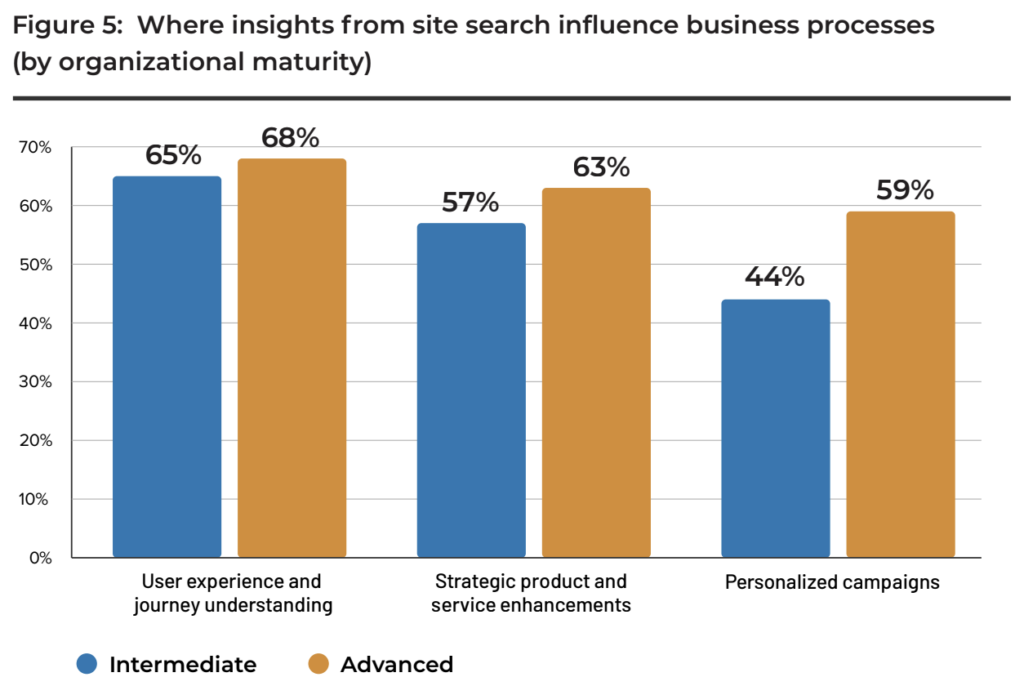
What’s more, the advanced organizations’ strategic use of site search shows up in the survey results. While 82% of respondents said site search is critical for understanding visitor intent, this increases to 91% for the advanced group. That ladders up to other significant differences:
- 49% of advanced organizations use search to increase lead quality (vs. 34% of beginners)
- 41% report revenue influenced by search behavior (vs. 26% of beginners)
- 59% of advanced organizations use search insights to drive personalized campaigns (vs. 44% of intermediate)
It’s a fundamentally different mindset. Instead of asking, “Is search working?” they ask, “What is search telling us?” That shift turns search from a passive feature into an active feedback loop.
From Site Search Queries to Outcomes
When you start treating search queries as signals, patterns begin to emerge.
You see the questions your content isn’t answering. You uncover demand for topics you hadn’t prioritized. You notice friction points where users expect one thing but find another. And from there, action becomes obvious.
You create new content where gaps exist. You promote high-value pages that align with common searches. You adjust taxonomy, tagging and structure to make discovery easier. You shape campaigns around real audience language instead of assumptions.
Marketers don’t need to add more tools or more data to take control of their website experience; they simply need to listen more closely to the signals already flowing through their websites.
The Cost of Ignoring What Visitors Are Telling You
When visitors can’t find what they’re looking for, they don’t keep digging. They leave. They bounce out of your site to Google or their AI search tools. They turn to competitors who can answer their questions faster.
And in today’s environment, that loss is amplified. AI-powered search experiences have changed how people discover information. Users are increasingly conditioned to ask direct questions and expect immediate answers. When they do land on your website, they arrive with higher intent and more specific needs.
If your search experience doesn’t capture and respond to that intent, you’re not just losing traffic. You’re losing qualified demand that has already made it beyond your front door.
Ready to Turn Your Search Bar Into Your Most Valuable Source of Customer Insight?
Download the full report to see how leading organizations are capturing and activating visitor intent.

Get Our Newsletter
The Stack is delivered bi-monthly with industry trends, insights, products and more

John Abbasi
|
Senior Editorial & Content Manager
Content marketing manager focused on brand storytelling, building SEO/GEO engines and elevating customer voices with a constant mission of weaving editorial quality and the value of site search technology into every piece of content.