 Optimizely



There’s a familiar tension inside most enterprise organizations.
Marketing teams are tasked with understanding the customer, shaping the journey and driving conversion. They’re closest to audience needs because they see intent signals.
But when it comes to one of the most critical touchpoints on the website — the site search experience — they often hit a wall. Because despite owning the digital experience, they don’t own the mechanism that helps website visitors find what they’re looking for.
And the data from our latest original research makes that gap clear: Only 39% of organizations say Marketing can directly tune or manage site search without IT involvement.
That isn’t just a process issue. It’s a growth problem.
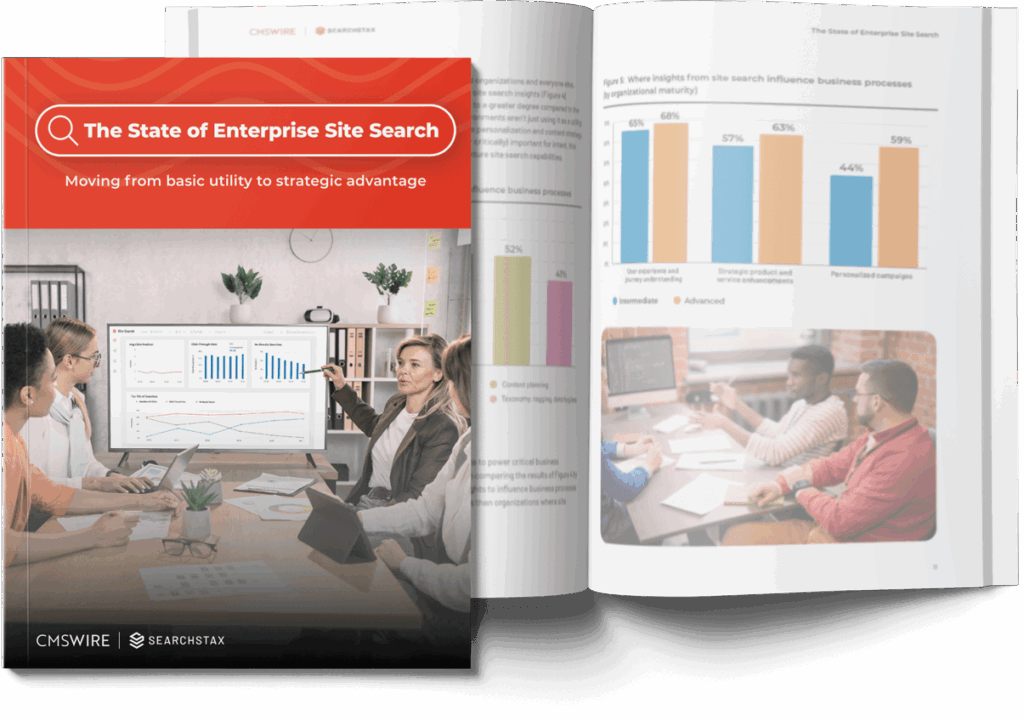
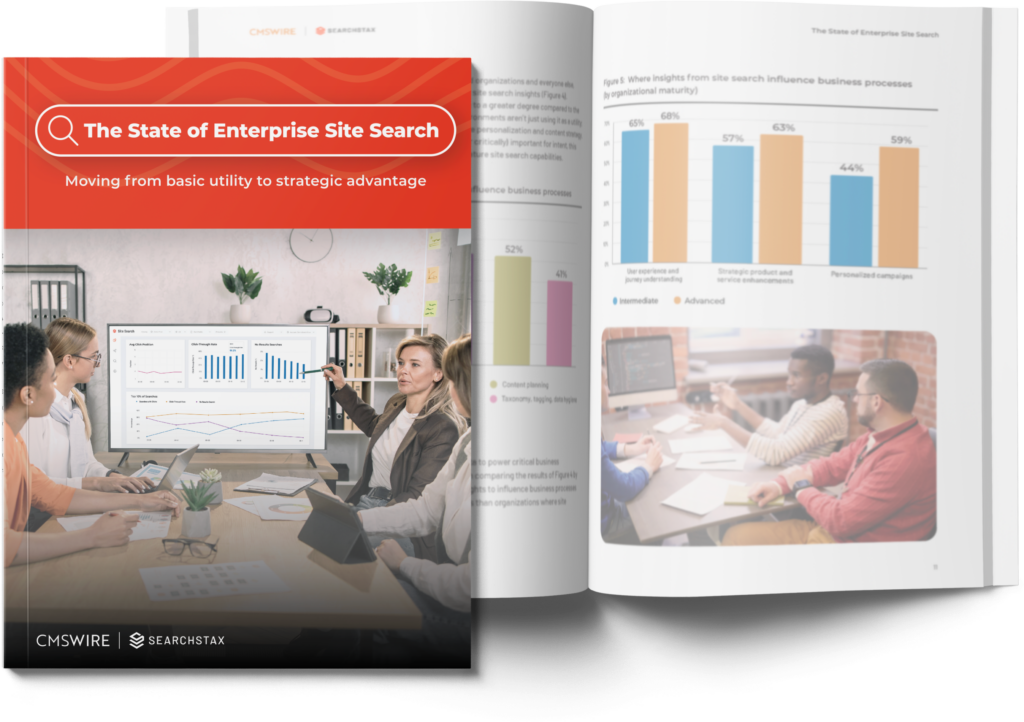
Our latest research report explores how enterprise teams are managing search ownership, optimization speed and AI readiness, and shows how mature teams are closing the gaps.
The Site Search Ownership Problem No One Wants to Own
Ask a simple question inside an enterprise organization: Who owns site search?
You won’t get a simple answer.
Some will point to marketing. Others to digital experience teams. IT often assumes ownership by default, since search sits within the technical stack. In reality it’s shared, and that’s where things start to break down.
Business leaders tend to believe search should sit closer to marketing or digital experience. Meanwhile, most IT leaders believe they own it outright.
This disconnect creates a gray area where no single team has full control, and no one can move quickly. At that point, search becomes everyone’s responsibility and no one’s priority.
"Visitors don’t see internal workflows or ticket queues. They just see irrelevant results, outdated content or friction in finding what they need. That’s when they leave to find what they need elsewhere."
When Marketing Can’t Move, Performance Suffers
Here’s where the impact becomes real.
Marketing teams are expected to respond to campaign performance, adjust messaging and optimize user journeys in near real time. But when search changes require developer support or IT tickets, that agility disappears.
A campaign launches, but the search results don’t reflect it. A high-value page exists, but it doesn’t surface for relevant queries. A trend emerges in search behavior, but no one acts on it for days or weeks.
These aren’t edge cases; they’re everyday friction points. And in a digital environment where timing matters, delays don’t just slow things down, they cause revenue leaks.
39% Isn’t a Benchmark — It’s a Bottleneck
It’s tempting to read that 39% figure and see progress. After all, some organizations have figured it out. But the more important takeaway is the inverse.
More than 60% of organizations still rely on IT involvement for even basic search adjustments.
That means the majority of marketing teams can’t directly act on the most immediate signals of customer intent from the queries in their own search bar.
It’s a structural bottleneck that limits how fast organizations can respond to their audience. And in a world where visitor expectations are shaped by instant answers on Google and AI-driven experiences with LLMs, that lag becomes increasingly visible.
The Speed Problem: Why “A Few Days” Is Too Late
Let’s talk about speed.
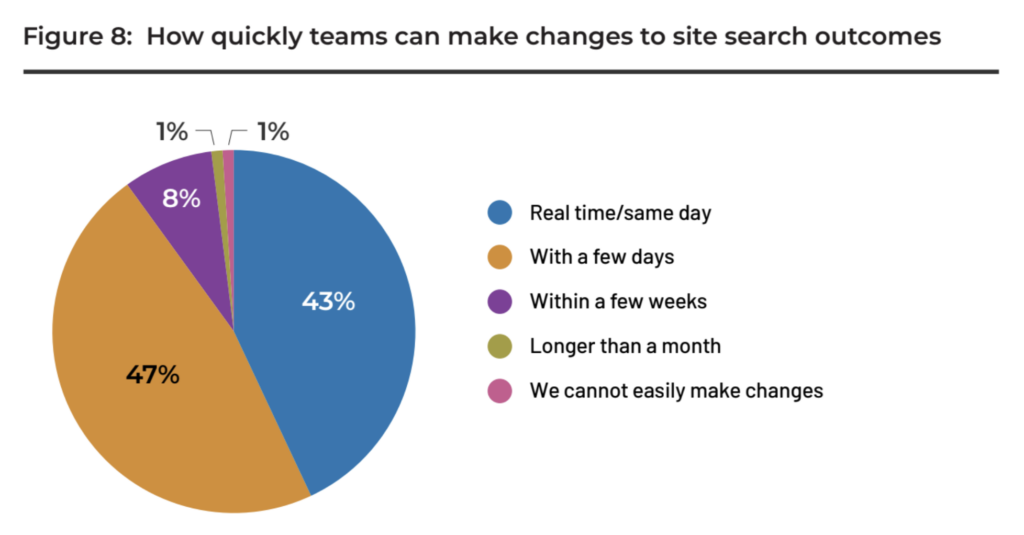
Only 43% of organizations say they can make changes to site search in real time or the same day. The rest take anywhere from a few days to several weeks.
On paper, a few days may not sound like a major delay. But in practice, it’s the difference between capturing demand and missing it entirely.
Search behavior shifts quickly. Campaign priorities evolve. New content is created. When teams can’t keep up, the search experience lags behind what visitors actually want.
Visitors don’t see internal workflows or ticket queues. They just see irrelevant results, outdated content or friction in finding what they need. That’s when they leave to find what they need elsewhere.
What Agile Search Ownership Looks Like
Getting site search ownership right, with the ability to respond to intent signals in real time, starts with a mindset shift.
Key to that shift is viewing search as more than just a technical function to maintain; it’s a dynamic experience that your team should pay attention to and optimize.
According to the research data, high-performing teams tend to be the ones who self-identify as having advanced site search maturity. Those teams have the ability to:
- Adjust relevance and rankings based on real-time needs
- Promote key content aligned with campaigns or priorities
- Respond immediately to trends in search behavior
- Use analytics to guide ongoing optimization
In this model, marketers don’t wait. They act. They treat search as an extension of their strategy, not a system they have to work around.
Breaking the Bottleneck Without Breaking Governance
Of course, this isn’t about removing IT from the equation. Search still requires strong technical foundations, integration and governance. IT plays a critical role in ensuring performance, security and scalability.
But ownership of the experience — the ability to shape what users see and how they find information — needs to sit closer to the teams who understand the audience.
When marketing and IT work from the same system, with clear roles and shared visibility, the friction disappears. Changes happen faster, insights turn into action and the search experience evolves in step with the business.
Closing the Gap Between Insight and Action
Marketing teams know what they need. When asked at the end of our research survey what they’d prioritize first in improving their site search, given no restrictions or budgetary constraints, here are some answers we got:
- “Faster search response time to enhance user experience.”
- “I would prioritize adding AI powered search in my website to increase visitor engagement.”
- “Improve relevance, speed and AI driven recommendations for users.”
- “I would prioritize improving search accuracy and relevance so users can find what they’re looking for faster without needing multiple searches.”
What they lack is the control and tooling to optimize search and satisfy those needs. Closing that gap between insight and execution is what separates organizations that treat search as a utility from those that use it as a strategic advantage.

Get Our Newsletter
The Stack is delivered bi-monthly with industry trends, insights, products and more

John Abbasi
|
Senior Editorial & Content Manager
Content marketing manager focused on brand storytelling, building SEO/GEO engines and elevating customer voices with a constant mission of weaving editorial quality and the value of site search technology into every piece of content.