Optimizely



December 04, 2025
Leslie Weller
|
Marketing teams that can pivot quickly in response to shifting market forces will win in the new era of always on, mobile everything, connected everywhere audiences.
Marketing used to make annual plans and execute campaigns over multiple-quarter time horizons.
With constant shifts in expectations and circumstances, the ability for marketing to adjust is key.
What Is Marketing Agility? And Why Does It Matter?
Marketing agility is the ability to quickly adjust strategies, campaigns, content and all digital touchpoints including onsite search experiences in response to data, market shifts and customer behavior while maintaining focus and quality.
Swiftly respond to market changes, competitor moves and unexpected events. Let’s explore a number of ways that marketing agility accelerates business outcomes, improves efficiency and drives better customer experience.
Marketing Agility vs. Agile Marketing
Before we go too deep, let’s touch on the difference between ‘marketing agility’ and ‘agile marketing’.
Agile marketing refers to the process of running marketing teams and projects based on scrum methodology. Agile marketing breaks down large campaigns into smaller sprints to be managed and delivered in shorter increments. Think keyword and ad testing in one sprint, landing page optimization in a second sprint and launching retargeting in a third sprint. This sprint-based approach does allow for some adaptations to external factors. However, agile marketing is primarily a project management approach for marketing team operations.
Marketing agility refers to an organization’s ability to quickly pivot and respond appropriately to unexpected market forces. The swiftness to respond is not chaos. It’s intentional adaptability. Marketing agility means that organizations can meet customers where they are, regardless of how frequently their needs change.
At its core, marketing agility demonstrates empathy for the immediate situation of its audience, whether their audiences are customers, patients, students or association members.
Organizations that prioritize marketing agility make decisions based on data and trends so that their brand touchpoints and service offerings keep pace with audience expectations.
Examples of Marketing Agility
Industry Examples
Financial institutions want to alert customers about fraud and scam tactics. They need to educate them about new ways scammers will try to collect private data and solicit money from seemingly harmless activities that pose significant financial risk with negative consequences.
They may have an ongoing drip campaign to checking account holders. These campaigns may be mostly ignored. Until there is a large data breach story in the news, and in that moment, people’s sensitivities are more open. So marketing teams that launch a fraud alert campaign immediately after a big news story, can drive more clicks, more education and awareness than other time periods. “Companies that are proactive about communication can turn a breach into an opportunity to demonstrate their commitment to security.”
In healthcare, marketing agility looks like adjusting the timing of promotions based on fluctuations in flu season.
In local government, a marketing team can turn a forecasted weather event into notifications on social media and its website of where to go for shelters, what to do in case of power outages and other emergency services. Its residents feel supported when marketing communications relate to the immediate needs of the community.
Data Insights Are the First Step Toward Marketing Agility
Since you can test ads and social media engagement within days or even hours, marketing teams have the ability to pivot faster than ever. Long gone are the Mad Men days when companies would spend a bunch of money on billboard, TV and radio ads and debate months later which channels were most financially lucrative.
Let’s not oversimplify this challenge. Important attribution discussions continue to live on in virtual and live boardrooms, and always will. But we also now have reporting and data insights to test messaging and visuals in near real-time with advertising dollars on digital channels, and via surveys.
Marketers can see what resonates and get actual market feedback quickly. Reviewing website engagement and conversion analytics provides valuable insights into what your audience wants and needs.
Paying attention to the data signals is the first step. And how quickly marketing teams do or do not take action on near real-time feedback is a barometer of a team’s marketing agility.
Marketing Agility Delivers Responsiveness and Empathy
Marketing agility demonstrates not only responsiveness, but also high levels of empathy to its audience. According to a 2025 Harvard Business Review article and Zurich Insurance study, “79% of respondents said that a brand’s ability to demonstrate empathy in their interactions with a customer factored into their choices” from a survey of 12,000 people across 11 countries.
Empathy ranked even higher as a decision factor to do business with that brand (79%), than online reviews (73%) and personal recommendations from family and friends (64%), in the same study.
You cannot show empathy when your marketing campaigns are rigid and something happens regionally, socially or financially to your target audience that you completely ignore.
Marketing Agility On a Macro Level Resonates With the Group
Marketing agility on a macro level responds to broad scale events. For example, it’s your team’s ability to launch or adjust a campaign when an unexpected disaster strikes. This macro event could be anything that affects a large portion of your target audience.
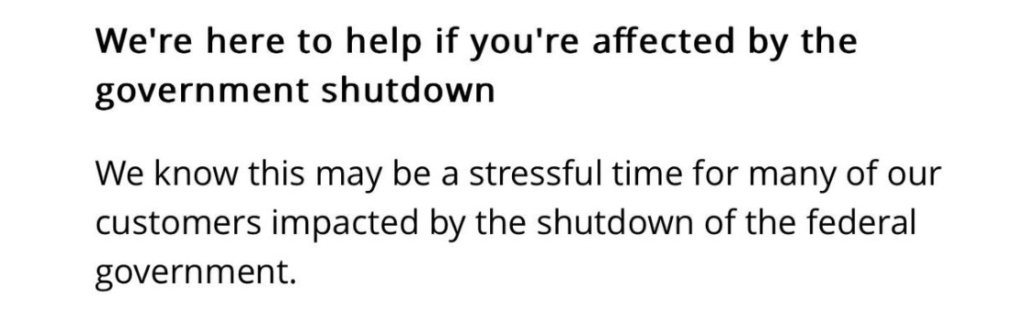
An example of marketing agility in response to macro factors are campaigns that get approved and launch quickly such as the push notifications in financial apps during the US government shutdown:
Marketing Agility on a Micro Level Exudes High-Touch Personalization
On a micro level, marketing agility addresses the changing circumstances of the individual customer.
Imagine a customer who has recently and unexpectedly lost their job. A financial institution’s customer relationship management (CRM) system still categorizes them as “high-earning professional” with messaging geared toward growing wealth. For that individual, seeing messages like “Boost your retirement contributions” or “Increase your investment portfolio” will sting more than satisfy. Reading those messages during a period of sudden financial insecurity is not the marketing team’s fault, but it can fall flat and create emotional distance from the brand at a moment when support would matter more.
Now contrast this with an experience where the same customer visits their banking website and starts searching for “options to pause loan payments” or “budget help after job loss”. No judgement, just a drop down list suggesting relevant support topics. At that moment, the institution has real-time insight that this person’s financial interest has shifted significantly. With fresh context as people type out what they’re looking for, the bank can respond with timely, empathetic content aligned to what the customer is actually experiencing right now. The customer tells the brand what is immediately top of mind and the brand responds appropriately. Trust is retained and deepened.
In healthcare, a new diagnosis, accident or sudden pain can completely shift the immediate concern of the patient. Due to privacy protections, health systems don’t leverage known information to target like they do in other industries, but being able to give answers to important questions at the moment patients want to find information is critical.
In higher education, a prospective student who gets their admission wait-listed may need different admissions details and deadlines than students who get acceptance letters.
Leading brands can organize their marketing team to address these micro moments and respond in-session with true real-time personalization. Brands that deliver contextually relevant experiences win brand loyalty and conversions.
This level of marketing agility at the micro level comes not because of data sitting in your warehouse – but because of the ability to respond to taps, keystrokes and click inputs that your audience is telling you that they need now. At this moment.
Real-time input is the most valuable first party data you can have and take action on. It’s what’s top of mind to your audience. With the right tools, your marketing team can meet your audience where they are, leading to higher conversions, better brand experience, and a stickier relationship.
Marketing Agility Is Not Marketing Chaos
Marketing agility does not equate to marketing chaos. But rather marketing agility exudes controlled adaptability. Marketing agility means having the metrics in place to learn in near real-time how your campaigns and channels are performing, and having the tools for marketing personnel to make ongoing improvements on a weekly, daily or even hourly basis depending on the pace of your industry.
5 Ways to Apply Marketing Agility In Practice
1. Update your website homepage promo banner and key landing pages within minutes or hours of new campaign data.
Example, promote a high demand loan product after a rate change.
2. Review your onsite search data to see what people are searching for, and adjust your content to match their expectations.
Increase of searches for “MBA cost” should prompt a fresh set of eyes on your tuition page and optimize the user experience.
3. Reprioritize content calendars using real website data.
Let data determine what moves up or down the content queue, not just vibes.
4. Deploy A/B testing and roll out winners in real time.
Run small tests and make immediate changes
5. Create quick-turn experiments (“learning sprints”) with cross-functional teams.
Make Marketing Decisions at the Speed of Data
In summary, marketing agility is the disciplined ability for organizations to adapt quickly and intentionally, whether responding to macro-level events that affect entire audiences or micro-moments that shape the needs of an individual.
By grounding decisions in real-time data, adjusting campaigns and content at the speed of customer behavior, and empowering teams with the tools to act swiftly, brands in financial services, healthcare, higher education and other information-rich industries can deliver more relevant, empathetic and effective experiences.
Marketing agility isn’t chaos; it’s controlled responsiveness that drives better outcomes, deeper engagement, and stronger trust in an era where expectations shift faster than traditional plans can keep up.
To learn more about how SearchStax can improve your team’s marketing agility through modern AI-powered Site Search, contact us.