 Optimizely
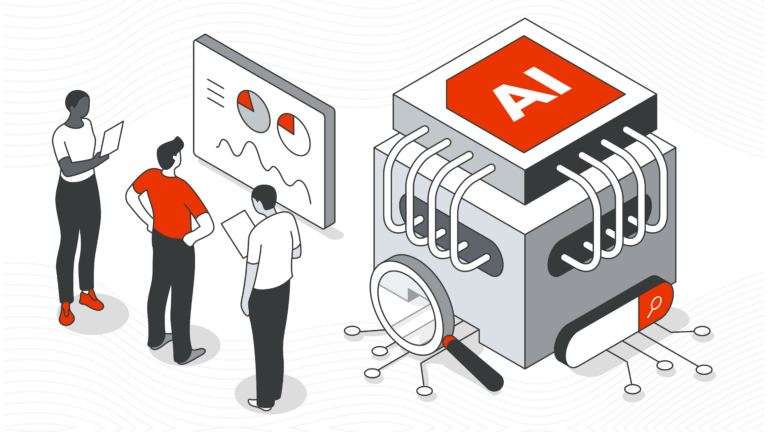

In January of 2026, Google published a blog post announcing major changes to Programmable Search Engine, the free tool many institutions still know as Google Custom Search, that quietly powers site search at thousands of colleges and universities. No press tour. A post addressed to “developer partners” announced a hard deadline buried in the middle: all transitions must be completed by January 1, 2027.
Read the announcement closely and the message is clear. Universities were never the customer. You were a use case Google tolerated. Now that tolerance has an expiration date.
What Changed With Google Programmable Search Engine?
Google is splitting Programmable Search Engine into tiers, and the free tier just got a ceiling (Google PSE Blog, Jan 20, 2026):
The free Search Element now caps at 50 domains. The “Sites to search” feature allows a maximum of 50 designated domains. That’s the entire free offering going forward.
“Search the entire web” is going away. If your engine queries more than 50 domains or searches the full web, you must transition to an alternative by January 1, 2027. To learn what Google’s replacement costs, you fill out a form and wait. Pricing is not published. Redditors discussing the subject have shared stories where they received $30K price quotes and even higher in some cases.
Custom Search JSON API users are being pushed to Gemini Enterprise Search. Google points API users toward Vertex AI Search, part of its enterprise AI and cloud ecosystem. That’s Google’s enterprise cloud product (formerly Vertex), with enterprise cloud pricing and enterprise cloud procurement. If your developers built a custom search interface on the JSON API, you’re migrating either way.
The door is already closed for new engines. As of the announcement date, all new engines must use “Sites to search.” Only existing engines get the grace period.
Why Google’s 50-Domain Search Limit Doesn’t Work for Higher Ed
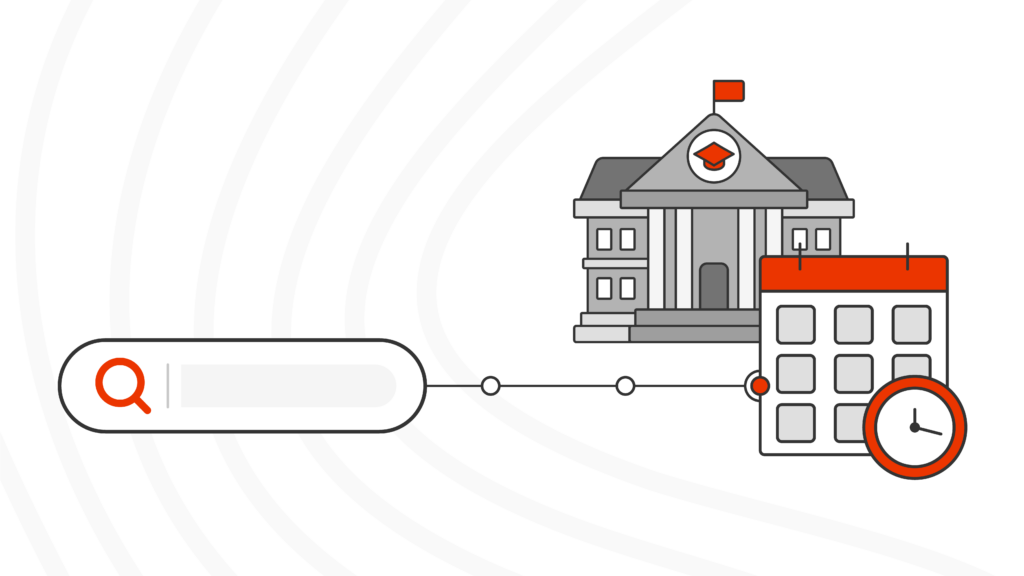
Universities operate web presences that include dozens or even hundreds of distinct domains and subdomains. A single large research university maintains separate domains for each school, department, research center, athletic program, hospital system and auxiliary enterprise (URL Categorization Database). The University of Chicago alone reports more than 5,000 web properties, many living on third- and fourth-level subdomains (UChicago Website Resource Center). A mid-sized university might have tens of thousands of pages spread across hundreds of subdomains (ImageX).
A corporate marketing site fits comfortably under 50 domains. Most corporate marketing sites were never running on Programmable Search Engine to begin with. A single-domain company either gets site search bundled into its CMS or pays for a dedicated stack from day one. Google’s free tier was always a fit for the simplest use case in the room.
Higher ed just happened to be the one industry that kept using a tool built for someone else’s problem, because it was free and nobody budgeted for the alternative. A university with a law school, a medical center, athletics, libraries, an extension program and 40 departmental microsites blew past 50 a decade ago.
"Google has proven consistently over the years that education isn’t a market it builds specific, longstanding solutions for. Instead, Google tends to exit the education market."
Which Colleges and Universities are Most Affected by Google’s Search Changes?
Research universities take the hardest hit. There are 187 R1 and 139 R2 institutions under the 2025 Carnegie Research Activity Designations (Carnegie Classifications). These campuses run the most decentralized web estates in existence: research labs, institutes, hospital systems, and federated departmental sites that each demanded their own domain years ago. Virtually none can fit under 50 domains without amputating something. They’re also the institutions most likely to have engineering teams that built custom search on the JSON API, which means forced migration.
Regional publics and comprehensives may be in the worst position. Their domain sprawl often rivals the R1s, but they lack the R1 budget and the engineering bench to implement and manage an enterprise solution like Vertex AI Search or negotiate Google’s unlisted full-web pricing. They have R1-sized problems with regional-comprehensive resources.
Community colleges and small privates aren’t safe either. Some fit under 50 domains today. But just because they “fit” doesn’t mean this is the optimal solution. A multi-campus community college district with separate campus sites, workforce development sites, continuing ed portals and a foundation site can hit the cap fast. And even institutions that squeeze under the line inherit a deliberately simplified free product with no roadmap commitment to academia. If Google moves the line again, who on your staff handles that migration?
Google’s History With Site Search Says Higher Ed Shouldn’t Wait for a Reprieve
This isn’t Google’s first exit from site search products that higher ed has relied on. Google Site Search was killed in 2017. Google Search Appliance was discontinued in 2019. Now Programmable Search Engine, the successor many users associate with Google Custom Search, gets carved down to a 50-domain box, and everything beyond it moves behind an interest form or toward enterprise offerings like Vertex AI Search.
Google has proven consistently over the years that education isn’t a market it builds specific, longstanding search solutions for. Instead, Google tends to exit the education market. Its enterprise AI search offerings are priced and architected for enterprise cloud customers, not for a web director with a flat budget, a CMS committee and a fiscal year that doesn’t bend.
Why Higher Ed Site Search is Uniquely Difficult
Here’s what a generic search tool never accounts for: one search box on a university site serves prospective students, current students, faculty, researchers, alumni and donors at the same time. The same query means different things to each of them. “Housing” from a 17-year-old applicant and “housing” from a visiting research fellow should not return the same results.
Meanwhile, the content behind that search box is managed by dozens of departments running their own subdomains, where keeping content accurate, current and brand-aligned becomes nearly impossible and decentralized sites create content silos (SimpsonScarborough). Search is the only layer that spans all of it. It has to connect visitors with relevant content across a fragmented digital estate, regardless of which CMS, department or subdomain contains that information. When search fails, the failure isn’t a lost e-commerce sale. It’s a lost applicant, and in 2026, every student counts.
How Universities Should Prepare for the Google Programmable Search Engine Deadline
Audit your domain count this quarter. Ask your web team one question: how many domains does our search cover? That single number determines your entire path forward, and every month you don’t know it is a month of runway gone.
Know which camp you’re in. Under 50 domains: you keep a stripped-down free tool with no roadmap and no guarantees. Over 50 domains or set to “search the entire web”: forced migration by January 1, 2027. Built on the JSON API: forced migration, period. There is no camp where doing nothing is a strategy.
Run an evaluation. You have three paths:
- Google’s enterprise AI search path, including Vertex AI search, built and priced for enterprise cloud customers.
- Google’s form-gated full web product, where you submit interest and wait to learn what it costs.
- Platforms built specifically for higher ed’s problem, like SearchStax, where a 300-subdomain web estate is the expected starting condition rather than an edge case.
Score them the way you’d score any critical system: quality of results, analytics, accessibility and what it takes to run each one with the staff you have. Also consider how easily the platform can search across decentralized domains and content sources, and how much control your digital team has to improve the experience without relying on developers for every change. The right answer varies by institution.
Budget now, not in the fall. January 1, 2027 lands mid-fiscal-year for most institutions. Evaluation, procurement and migration takes months. Start now and you’ll have a leg up.
The institutions that start now decide who they migrate to and on what terms. The ones that wait find out in December that the decision got made for them.
Meet with a Search Expert
Let’s talk about your options before the Google PSE Deadline.

Jeff Dillon
|
Digital Strategist, Higher Education
Digital Strategist focusing on helping institutions with their digital challenges including Site Search, AI, Personalization and content management. He focuses on telling the stories that resonate with prospective customers